
Dry Needling vs. Acupuncture: Clearing the Confusion and Why Acupuncture Offers More
- Jun 15, 2023
- 8 min read
Updated: Feb 12

If you've been searching for relief from muscle pain, tension, or chronic discomfort, you've probably encountered "dry needling." It's a popular technique, but many wonder: Is it the same as acupuncture? Or something entirely different? In this guide, we'll explore the differences, trace dry needling's roots, and highlight why full acupuncture—rooted in Traditional Chinese Medicine (TCM)—provides a more comprehensive, evidence-supported approach.
What Is Dry Needling?: A Targeted Technique
Dry needling involves inserting thin needles into myofascial trigger points—those tight, irritable knots in muscles that refer pain elsewhere. The goal is mechanical: to release tension, improve blood flow, and reduce local inflammation, often eliciting a therapeutic "twitch response."
It's commonly used for musculoskeletal issues like back pain, headaches, or sports injuries. Dry needling is often paired with exercise and other PT techniques to prevent trigger points from reoccurring.
The needles used in dry needling are solid and do not inject any liquid into the body, which is why it is called 'dry' needling.
The popularity of dry needling increased significantly after the year 2000, leading to the establishment of competencies for physical therapists by the Federation of State Boards of Physical Therapy in 2015.
Most people believe it belongs to sports Physical Therapy techniques, but actually it is a technique from Acupuncture developed way earlier than PT schools were created.
Electrical Stimulation

Physical therapists often combine dry needling with electro-stimulation (attaching electrodes to the needles to deliver gentle electrical pulses). This boosts muscle release, pain relief, and circulation—making it very effective for many musculoskeletal conditions.
What’s less known: electro-stimulation on needles originated in China within Traditional Chinese Medicine, not in physical therapy. Known as electroacupuncture, it emerged in the 1930s–1950s as an evolution of ancient acupuncture to intensify effects for pain management and surgery analgesia. Chinese practitioners refined it decades before it entered Western PT practice. In TCM, electroacupuncture enhances Qi flow and meridian balance while targeting specific patterns (e.g., Qi stagnation or Blood stasis). The electrical pulses are adjusted to support holistic healing, not just local relief.PTs now use this valuable add-on, but acupuncturists have been mastering it within a complete TCM framework for much longer—giving them an advantage for deeper, longer-lasting results in complex cases.
Physical Therapy
Physical therapists (PTs) do excellent work in rehabilitation—helping patients recover from injuries, surgeries, and movement challenges through expert exercise, manual therapy, and functional training. Their contributions are essential and deeply respected.
Many PTs incorporate powerful techniques that originated in Traditional Chinese Medicine (TCM), such as:
Dry needling
Electro-stimulation on needles
Cupping
Gua sha
These methods have deep roots in TCM and were developed within its holistic framework long before their adoption in modern physical therapy.
While PTs use them in rehabilitation, licensed acupuncturists (L.Ac.) receive far more extensive training in these exact techniques—typically 3–4 years of graduate-level education with thousands of hours focused on needling, meridians, pattern diagnosis, and adjunct modalities.
This depth often allows for more customized, whole-body application, especially for complex or recurring issues.Both professions offer unique strengths. PTs shine in movement restoration; acupuncturists bring specialized mastery of these TCM-derived tools plus a systemic perspective. Many patients benefit when both are respected and available.
Key takeaway: When seeking these specific techniques, TCM practitioner's level of \ training can often produce better results.
Acupuncture: Holistic System of Healing
Acupuncture, part of TCM, uses the similar thin needles as dry needling but with a broader intent: to regulate Qi (vital energy), balance yin and yang, and harmonize the body's meridians. The thin needles inserted at specific points to address not just symptoms but underlying patterns, promoting overall wellness.
Acupuncture works by stimulating these meridian points to:
Restore the smooth flow of Qi.
Achieve balance between yin (passive, cooling, nourishing aspects) and yang (active, warming, transformative aspects)—two complementary, opposing forces that must remain in harmony for well-being.
Address underlying patterns of disharmony (e.g., Liver Qi stagnation from stress, Blood stasis causing sharp pain, or Damp-Heat leading to swelling), rather than just treating isolated symptoms.
This broader intent promotes not only pain relief but also overall wellness—improving sleep, digestion, mood, immunity, and resilience to stress. Sessions are typically relaxing and integrative, often incorporating diagnostic tools like pulse and tongue examination to tailor treatment to the individual's unique constitution and pattern.
In short, acupuncture doesn't just "fix" a problem; it supports the body's innate ability to heal by restoring equilibrium across physical, emotional, and energetic levels.
Dry Needling Treatment and Acupuncture: Key Differences in Approach and Application
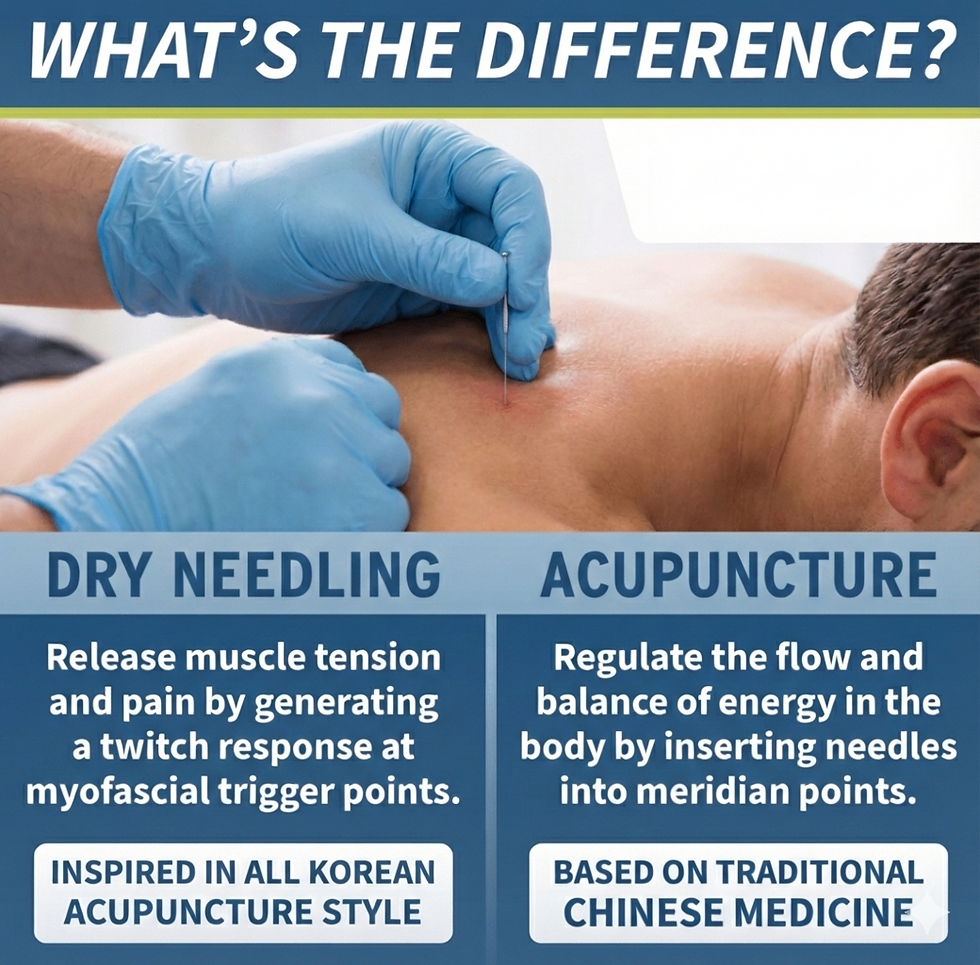
Dry needling and acupuncture use similar needles, but their methods and goals differ significantly:
Dry needling (typically done by physical therapists) is a targeted, Western-style technique. It focuses narrowly on myofascial trigger points in the painful area to release muscle tension and reduce local inflammation. Trigger point dry needling treatment is symptom-focused and mechanical.
Acupuncture (within Traditional Chinese Medicine) takes a holistic view. It addresses underlying patterns of imbalance—such as Qi stagnation, Blood stasis, or Damp-Heat—using both local and distal points (often far from the pain) to restore overall energy flow and promote systemic healing. Sessions are integrative and usually more relaxing.
Example: Treating shoulder pain with Dry needling and Acupuncture:
Dry needling approach: Needles are inserted directly into trigger points in muscles to elicit a twitch response and provide quick local relief. It’s effective for short-term pain reduction and improved mobility but mainly treats the symptom itself.
TCM acupuncture + herbs approach: The practitioner first diagnoses the root pattern (e.g., Liver Qi stagnation from stress or Blood stasis from poor circulation). Local points (e.g., LI-15 on the shoulder) are combined with distal points (e.g., LI-4 on the hand or LV-3 on the foot) to unblock meridians and regulate the whole system. A customized herbal formula (such as Xiao Yao San for Qi stagnation or Shen Tong Zhu Yu Tang for Blood stasis) supports deeper, longer-lasting resolution by addressing contributing factors like stress, inflammation, or circulation.
The Surprising Origins: Dry Needling's Korean Roots
Contrary to the idea that dry needling is a purely modern Western invention, targeted needling techniques trace back to Korea over 300 years ago. During the Joseon Dynasty, Korean practitioners developed precise methods for addressing local pain and imbalances.
While modern "dry needling" as a specific Physical Therapy Western medical technique (focusing on myofascial trigger points without traditional Eastern theory) emerged in the mid-20th century, targeted needling methods that bear strong similarities—such as precise insertion into tender or imbalanced points for local pain relief—do indeed trace back to Korean acupuncture developments during the Joseon Dynasty (1392–1897 CE), over 300 years ago. This is particularly linked to Sa'am (also spelled Saam) acupuncture, a system that originated in Korea around the 17th century. As you can see, dry needling is not a western medicine invention.
Ancient Korean Texts: Detailed Guidance from Centuries Ago
Sa'am (or Saam) acupuncture, documented in classical texts from the 17th century (estimated 1644–1742), describes detailed needling strategies using as few as four needles to correct imbalances. These include targeting tender "Ashi" points—remarkably similar to modern trigger points—for pain relief and functional restoration. These historical Korean books provide clear instructions on point selection and technique, predating Western descriptions by centuries.
Dry Needling as a Subset of Acupuncture
In essence, dry needling is one technique within the vast acupuncture tradition. TCM has long used Ashi points and local needling for muscle issues. Modern dry needling adapts this for Western anatomy, but it borrows from the same foundational toolset that acupuncturists have mastered for millennia.
The Education Gap: Depth vs. Brevity
Licensed acupuncturists complete rigorous training: typically 3–4 years (master's or doctoral level), with 3,000+ total hours, including 950–1,000+ in clinical needling practice. This covers TCM theory, anatomy, safety, and pattern diagnosis.
Dry Needling Certification: Often Just Weeks of Training
PTs adding dry needling usually complete 24–100 hours (often weekend courses), focusing on trigger points and anatomy. While valuable, this is a fraction of an acupuncturist's needling-specific education—highlighting a significant difference in depth and scope.
Safety Data: Lower Risks with Extensive Training
Minor adverse events (e.g., bleeding, bruising, temporary soreness) occur in 19–37% of dry needling treatments in PT surveys, while acupuncture reports lower rates (~6–9% in large-scale studies). Serious events like pneumothorax are extremely rare for both (<0.1%), but extensive training in acupuncture contributes to consistently strong safety profiles.
Dry needling and acupuncture are considered safe treatments.
Efficacy Comparison: Short-Term vs. Long-Term Benefits
Meta-analyses show dry needling (perform by physical therapists) effective for short-term musculoskeletal pain relief. However, acupuncture often outperforms in sustained outcomes. For example, studies on neck pain and chronic conditions indicate acupuncture provides 20–30% better long-term pain reduction and function due to its holistic approach.
Acupuncture frequently demonstrates stronger performance in sustained, long-term outcomes.
This stems from its holistic approach, which addresses underlying imbalances rather than just local symptoms. Key supporting evidence includes:
Large-scale individual patient data meta-analyses (e.g., Vickers et al., 2012, involving 17,922 patients) found acupuncture superior to sham and no-acupuncture controls for chronic pain conditions (including back/neck pain, osteoarthritis, and headaches), with effects persisting over time and only a small decline at 1 year.
Specific comparisons for neck pain show acupuncture providing more consistent long-term relief; for example, reviews indicate sustained reductions in pain and disability at 3–6 months or beyond, often outperforming isolated needling techniques by addressing contributing factors like stress or systemic inflammation.
In chronic musculoskeletal conditions, acupuncture has been linked to 20–40% greater improvements in pain and function over months compared to short-term-focused interventions, thanks to its systemic regulation of Qi, meridians, and patterns.
In contrast, while dry needling excels in rapid, localized relief (e.g., immediate to medium-term gains in trigger point deactivation), evidence for its long-term superiority is limited or inconsistent—many reviews note effects fade beyond 12 weeks without additional interventions.
Both can be valuable; many patients benefit from integrating elements of both when appropriate.
Probably the best approach choose a well trained Acupuncturist rather than a physical therapists and get the benefit of both dry needling treatment and acupuncture.
Why Acupuncture Goes Deeper: Treating the Root
Dry needling treatment (Physical Therapy style) addresses symptoms effectively but may not prevent recurrence. Acupuncture treats underlying patterns—improving sleep, stress, digestion, improves blood flow and immunity alongside pain. Research (e.g., NIH and Cleveland Clinic reviews) shows broader benefits, like reduced inflammation markers and enhanced quality of life.
Dry needling focuses exclusively on treating musculoskeletal and neuromuscular pain by releasing trigger points.
Acupuncture treats a wide range of conditions, including pain, fatigue, infertility, headache, insomnia, anxiety, and depression.
Evidence Spotlight: Acupuncture's Superior Outcomes
In fibromyalgia and chronic pain trials, acupuncture reduced symptoms by up to 40% vs. lower rates for isolated dry needling. Network meta-analyses confirm acupuncture's edge in functional improvement and patient satisfaction (95%+ in some reviews vs. ~80% for dry needling alone).
Choosing the Right Practitioner: Expertise Matters
Licensed acupuncturists undergo rigorous, comprehensive education: typically 3–4 years of master's or doctoral programs, totaling 3,000–4,000+ hours of training. This includes extensive needling-specific coursework (often 950–2,600+ hours in clinical and theoretical practice), anatomy, safety protocols, pattern diagnosis, and supervised clinical hours.
This depth equips them to handle not only local trigger points but also systemic imbalances, distal points, and integrated therapies like herbs or moxibustion. In contrast, physical therapists (PTs) adding dry needling certification usually complete 24–100 hours (often 27–80 hours via weekend or short courses), focusing primarily on trigger-point anatomy and technique.
While PTs excel in musculoskeletal rehabilitation, their needling-specific training is a small fraction of an acupuncturist's—equivalent to a specialized add-on rather than foundational expertise.
Final Thoughts: Embrace the Full Potential
Dry needling is a valuable technique with historical roots in Korean acupuncture traditions—but it's only one piece of a much larger puzzle. Acupuncture's depth, evidence base, and holistic benefits make it a superior choice for lasting, whole-body wellness. If you're dealing with pain or seeking deeper relief, consider a qualified acupuncturist who can incorporate targeted needling within a full TCM framework. Reach out to Soul Acupuncture & Herbal in Fort Lauderdale—mention this article for a complimentary consultation. We'd love to help you restore balance and feel your best.


Comments